
Why doing Chesed isn't enough (and what the Avos knew)
Ever notice how you can check "Chesed" off your daily list and still feel like something's missing? You helped a neighbor, you dropped off a meal, you held the door — and yet, deep down, it all felt a bit… routine. Flat, even. Here's the thing: the Torah doesn't just ask us to do Chesed. It asks us to love it.
The verse that changes everything about Chesed
There's a pasuk that most of us glance right past. It says "doing justice and loving kindness" — not "doing kindness." The word isn't "Asos Chesed" but "Ahavas Chesed." That single word — love — transforms the entire Mitzvah.
The Chofetz Chaim devoted an entire sefer to this idea. He observed that too many people treat Chesed like an obligation they power through. A chore on the to-do list. But when the Torah tells us to love Chesed, it's describing a completely different relationship with giving. It's the difference between eating because you have to and eating your favorite food because you can't wait to taste it.
And that distinction? It's exactly what separated the Avos from ordinary people.
Avraham Avinu wasn't just generous — he was a Chesed fanatic
Picture the scene. Avraham Avinu had just had his Bris Milah. He was recovering from surgery. Hashem made the day blazing hot specifically so no travelers would come by and disturb him. By every measure, Avraham was exempt from hosting anyone.
So what did he do? He sat at the entrance of his tent, scanning the desert for guests. And when none appeared, he was upset.
Think about that for a moment. He had zero obligation. No guests meant no Mitzvah to fulfill. It would be like feeling distressed that you can't keep Shabbos on a Tuesday. It makes no sense — unless Chesed isn't just something you do. It's something you love so deeply that the absence of it causes you pain.
That's why Hashem sent three Malachim disguised as travelers. Not because Avraham needed the Mitzvah points. Because Hashem saw that Avraham's heart was aching to give. As Torah Live's Ahavas Chesed video beautifully illustrates, Avraham didn't just welcome those guests — he ran to greet them, personally selected the finest animals from his herd, and prepared the meal himself. He had hundreds of servants. Why not delegate? Because he wanted to do it with his own hands.
What happened after the angels left tells you even more
The very next thing the Torah tells us about Avraham is that he davened for Sodom. Sodom — the city that had outlawed acts of giving. The place that punished people for being kind. The polar opposite of everything Avraham stood for.
But Avraham cared about people. Even wicked people. Even people who had made cruelty into law. He thought: maybe there are a few righteous individuals among them. So he pleaded with Hashem on their behalf.
And after Sodom was destroyed? Avraham moved. Why? Because there was no one left in the area to do Chesed for. Have you ever heard of someone uprooting their entire household because they didn't have enough opportunities to give? That's not obligation. That's not duty. That's Ahavas Chesed — a burning, restless love for giving that simply cannot sit still.
Rivka proved it wasn't just an Avraham thing
When Eliezer arrived at the well, he was a big, strong, able-bodied man with his own two hands. Rivka, on the other hand, was a young girl. If anyone could have reasonably thought, "He can handle it himself," it was her.
But Rivka didn't just offer Eliezer a drink. She offered to water all ten of his camels. Do you know how much water a single camel drinks after a long desert journey? An enormous amount. Multiply that by ten, and imagine a young girl carrying heavy jugs of water back and forth, again and again.
Nobody asked her to do that. Nobody expected it. But she saw a weary traveler, and all she could think was: here's a beautiful opportunity to help. That's the mark of someone who doesn't just do Chesed. She loved it. It lit her up from the inside.
The deepest reason: we were literally created for this
Here's what ties it all together. Hashem is all-powerful. He doesn't need anything from us. So why did He create human beings? Not because He needed something — but because He wanted to give. The greatest good Hashem could give us is the ability to form a relationship with Him. To be close to Him.
But how does a person become close to the Creator of the universe? The Torah tells us: "You shall walk in His ways." We become similar to Hashem by emulating His characteristics. Just as He is a giver, we should be givers. Just as He is merciful and kind, we should be merciful and kind.
Rabbi Dessler explains this idea with remarkable clarity. A giver doesn't give because the world demands it. A giver gives because giving is who they are — it flows from their very essence. The Avos understood that Chesed isn't just a nice thing to do. It's the reason we exist. It's the purpose Hashem wired into our Neshamos.
That's why giving feels so good. Not because of some chemical reaction. Because when you give, you're aligning with the deepest part of who you are — a being created in the image of a giving G-d.
Why the world has so many problems (and why that's actually good news)
Ever wonder why Hashem created a world with so much that needs fixing? It's not a design flaw. It's the design itself. Every broken thing, every person in need, every gap waiting to be filled — those are invitations. Hashem placed them there to give us the opportunity to become more like Him.
When you see a neighbor struggling, that's not a burden — it's a gift wrapped in wrapping paper you didn't expect. When someone needs a ride, a meal, a listening ear, or even help with a glitchy iPad — that's Hashem saying: here, this one's for you.
The Avos didn't wait for Chesed to find them. They went looking for it. They lifted their eyes — actively scanning their surroundings for ways to help. And that's exactly what we're called to do.
Five ways to start loving Chesed today
Ask the question every time you meet someone. Before every interaction, pause and think: "What can I do for this person?" It might feel forced at first. But with practice, it becomes second nature — a reflex that rewires how you see other people.
Look for Chesed when you're "exempt." The real test of Ahavas Chesed isn't what you do when it's convenient. It's what you do when nobody expects anything from you. Tired after a long day? That's your Avraham-at-the-tent-entrance moment.
Do it yourself when you could delegate. Next time you have the option to personally help someone versus passing it off, choose to do it with your own hands. Avraham had servants. He still ran. There's something powerful about personal involvement.
Expand beyond your comfort zone. Rivka watered ten camels for a stranger. Start small — carry someone's groceries all the way inside instead of just to the door. Offer more than what's expected. Let your Chesed overflow past the minimum.
Spend time learning about the Avos. Study how Avraham, Sarah, Rivka, and the other Avos and Imahos lived. The more familiar you become with their ways, the more their love for giving seeps into your own life. Their stories aren't just history — they're a blueprint for becoming who you were created to be.
From so-so giving to a Chesed revolution
Here's the honest truth. Most of us are what you might call "so-so givers." We do Chesed, sure. But we don't crave it. We don't scan the room for it. We don't feel that ache in our chest when there's no one to help.
But that can change. And it starts with one shift in perspective: Chesed isn't something you do because you have to. It's something you were created to love. The Avos weren't superheroes with powers we can't access. They were human beings who understood the truth about why we're here — and they let that truth set their hearts on fire.
During these Three Weeks, as we mourn the Churban and long for the rebuilding of the Beis Hamikdash, there's no better time to ask ourselves: am I doing Chesed, or do I love Chesed? Because a world rebuilt on Ahavas Chesed — that's a world ready for redemption.
So the next time you meet someone — anyone — pause. Lift your eyes. And ask yourself: what can I do for this person?
You might just find that the answer transforms your entire day.
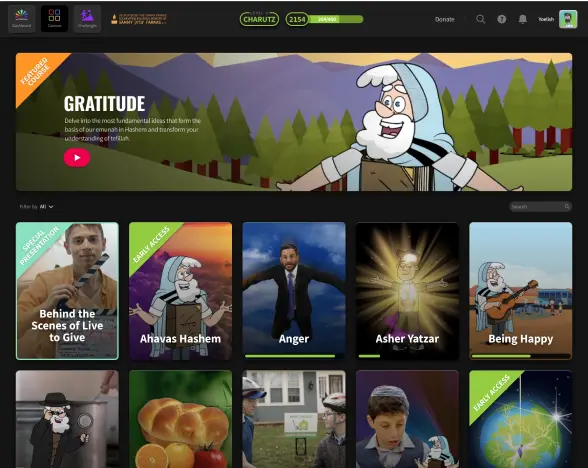
Ready to bring these ideas to life with your family? Torah Live's stunning videos, interactive challenges, and games turn powerful Torah concepts into unforgettable experiences — 100% clean and 100% fun. Sign up for free and watch Chesed become your family's favorite conversation topic.