
How a tiny dot teaches your child more than just Aleph Bais
Here's something worth thinking about: the difference between two Hebrew letters — Bais and Vais — comes down to a single dot. Remove it, and the letter changes. The sound changes. Even the name changes. And if you think that's just a quirky detail of the Aleph Bais, think again — because the way your child learns that difference could shape how they feel about Torah for years to come.
Meet Baz: the Bais who lost his dot
In one of the most charming Aleph Bais lessons you'll find, a gifted Morah tells the story of Baz — a little Bais who goes for a walk up a hill. His mommy warns him to be careful, because a strong wind might blow his ball away. Sure enough, the wind does exactly that. And when Baz comes home without his ball — the dot that sits inside the letter Bais — his mommy doesn't even recognize him.
"Who are you?" she asks. "You're not Baz. You're Vaas!"
It's a simple story. A young child can follow every word. But inside that simplicity is something powerful: a lesson that sticks. Because now, every time your child sees a Bais and a Vais side by side, they won't just see two similar-looking letters. They'll remember Baz, his windy hill, and the adventure of finding his ball again. That's not just reading instruction — that's learning that lives in a child's imagination.
Why storytelling is the secret to Aleph Bais success
Every experienced Morah knows something that research has confirmed many times over: children remember stories far longer than they remember rules. Tell a five-year-old that Bais has a dot and Vais doesn't, and they might remember it for a day. Tell them the story of Baz losing his ball in the wind, and they'll remember it for years.
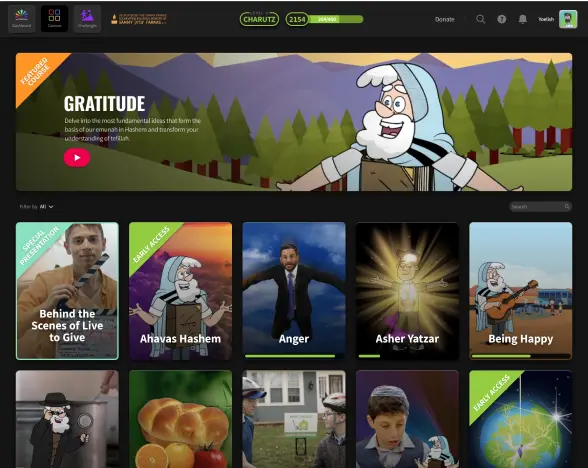
This is the approach behind Torah Live's Lessons for Little Ones series. Drawing on years of kindergarten teaching experience, each letter gets its own world. Each lesson feels like an adventure. Songs, puppetry, games, and storytelling come together to teach Aleph Bais in a way that children actually want to come back to.
And that matters more than we might realize. Because the Aleph Bais isn't just a set of 22 symbols to memorize. It's the doorway to Torah. It's how a child first connects to Chumash, to Siddur, to the words of Chazal. When that first connection is warm and joyful, it sets a tone. When it feels like a chore, well — we all know how that goes.
Small details carry big weight in Torah life
There's something fitting about learning this lesson through the Aleph Bais itself. In Torah life, small details are never just small. The difference between Bais and Vais is one tiny dot — but it changes the sound, the meaning, and the word entirely.
This idea echoes throughout Halacha. A Mezuzah placed a few centimeters too low. A Brachah said with one wrong word. The small things carry enormous weight because the Torah teaches us that precision matters — that Hashem pays attention to the details, and so should we.
When we teach our children to notice that little dot inside the Bais, we're quietly building something bigger. We're training them to pay attention. To see differences that other people miss. To understand that in Torah — as in life — the things that seem tiny often turn out to be the things that matter most.
Making the first impression count
Rabbi Shlomo Wolbe writes extensively about the importance of a child's early experiences with learning. He emphasizes that the emotional atmosphere surrounding Torah education shapes a child's relationship with Yiddishkeit far more than the specific content being taught. A child who associates learning with warmth and delight will naturally seek more of it.
This is exactly why the how of Aleph Bais instruction matters so much. It's not enough to teach the letters correctly — though accuracy is, of course, essential. The question is: does the child walk away smiling? Do they ask to watch the lesson again? Do they run to their parents and retell the story of Baz and his lost ball?
If the answer is yes, you've done something far more valuable than teaching a letter. You've planted a seed. You've created a positive association with Torah learning that can last a lifetime. And in a world full of distractions competing for your child's attention, that positive association is worth its weight in gold.
Five ways to bring Aleph Bais to life at home
You don't need to be a trained Morah to reinforce these lessons. Here are five things you can do today to make Aleph Bais learning joyful and memorable for your child.
Retell the stories together. After your child watches a lesson, ask them to tell you the story in their own words. When they retell the tale of Baz and his ball, they're not just reviewing — they're owning the knowledge. Let them add details, act it out, even change their voice for different characters.
Go on a letter hunt around the house. Pick a letter of the week — say, Vais — and challenge your child to find it on food packages, Sefarim, posters, or anything with Hebrew text. Each time they spot it, they get to shout the letter name out loud. Trust me, they will love this.
Connect letters to real objects. Vais makes a vvv sound. What else makes that sound? A vacuum? The wind outside? Help your child link the letter's sound to things they already know. The more connections they build, the stronger the memory becomes.
Celebrate the small wins. When your child correctly identifies the dot inside the Bais — or notices that the Vais is missing it — make a big deal out of it. A high five, a proud smile, a "You remembered!" goes a long way toward building confidence and motivation.
Watch the lessons more than once. Repetition is not the enemy of engagement when the content is good. Children love rewatching things they enjoy. Each viewing deepens their understanding and strengthens their recall. Let them revisit their favorite Aleph Bais videos as often as they like.
The gift that keeps giving
Here's the thing about teaching Aleph Bais well: it's not a one-time event. It's the foundation of everything that follows. Every Pasuk your child will learn in Chumash. Every Tefillah they'll say. Every page of Gemara they'll one day tackle, b'ezras Hashem. It all starts here — with these 22 letters and the way we introduce them.
When you give your child a joyful Aleph Bais experience, you're giving them something that compounds over time. You're making Torah feel like home. You're making Hebrew feel like a friend, not a stranger. And you're showing them — right from the start — that learning Torah is one of the most exciting things a person can do.
So the next time your little one points to a letter and says, "That's Baz! He has his ball!" — smile. Because in that moment, your child isn't just reading a letter. They're stepping through the door into a lifetime of Torah.