
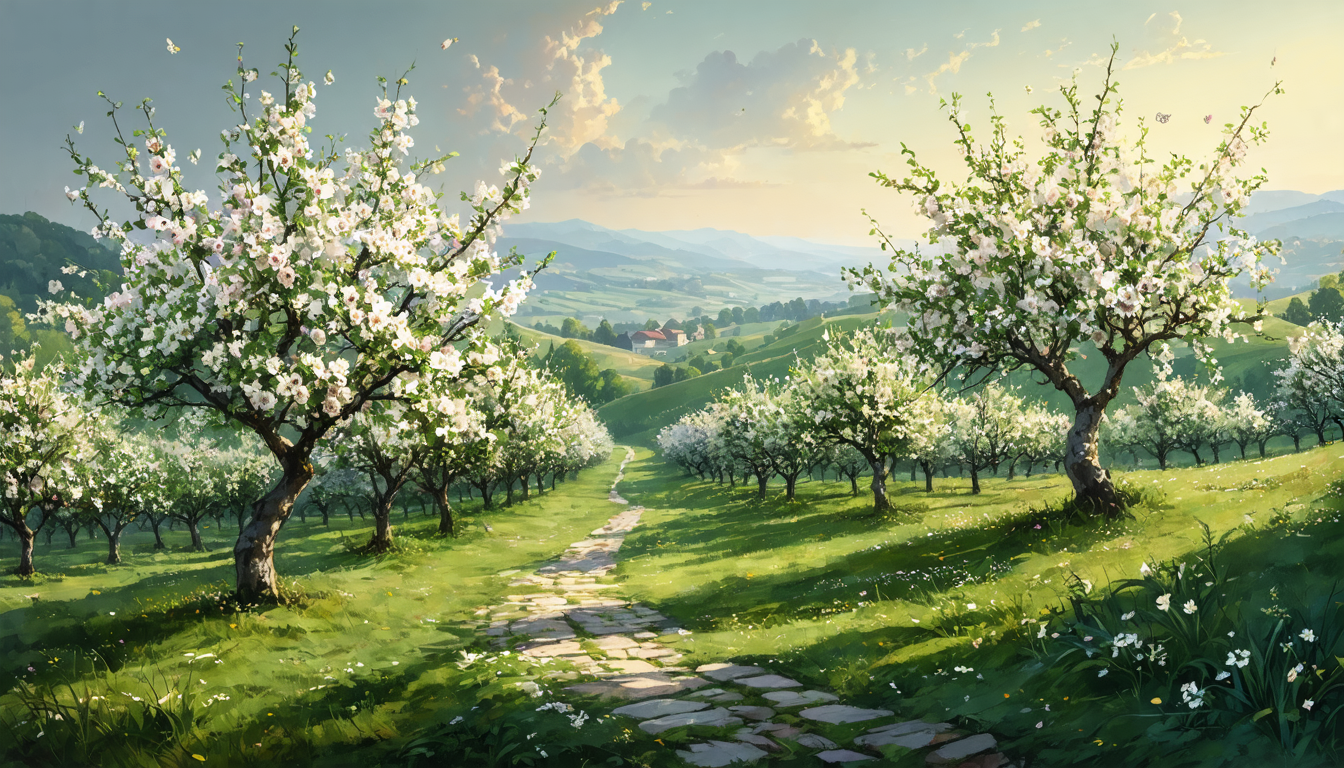
How to say Birkat Ha'ilanot the right way this spring
There's a Bracha you can only say once a year — and if you blink, you might miss it. Birkat Ha'ilanot, the blessing we make on blossoming fruit trees each spring, has a remarkably short window. Get the timing wrong, pick the wrong tree, or just keep putting it off, and suddenly the moment has passed.
The good news? Getting it right isn't complicated. It just takes a little know-how and a lot of eagerness. Let's walk through exactly how to make your Birkat Ha'ilanot count.
When is the right time for Birkat Ha'ilanot?
The Shulchan Aruch tells us to say Birkat Ha'ilanot in the month of Nisan, because that's when trees blossom in Eretz Yisrael. Spring arrives, everything bursts to life, and the timing is perfect.
But what if you live somewhere where spring shows up fashionably late? If your trees only blossom in Iyar or Sivan, you say the Bracha then. And if you live in the Southern Hemisphere — South Africa, Australia, or Argentina — your spring falls around Tishrei, so that's your time.
The key principle is simple: the Bracha follows the blossoms, not the calendar date.
Why the rush to say it early?
There's a beautiful concept in Halacha called zerizin makdimin l'mitzvos — those who love Hashem's Mitzvos rush to do them at the earliest opportunity. It's not about checking a box. It's about showing that we genuinely want to serve Hashem, that a Mitzvah isn't a burden but a privilege.
That's why many people make a point of saying Birkat Ha'ilanot on Rosh Chodesh Nisan itself — the very first chance they get. Some especially righteous individuals even rise at dawn to Daven at Netz, so they can recite the Bracha immediately after Davening.
Rav Shlomo Zalman Auerbach said about himself that from the age of 13, he never once missed making this Bracha. Not a single year. That's decades of quiet, consistent devotion to a Mitzvah that takes less than a minute.
But don't panic if Rosh Chodesh Nisan slips by. You have the entire month. And if Nisan passes too, you can technically say it anytime during your local spring season. The main thing is — don't let it slip away entirely.
Which trees qualify for the Bracha?
This is where people sometimes trip up. Birkat Ha'ilanot can only be said on fruit trees. A gorgeous ornamental tree covered in breathtaking pink flowers? Beautiful to look at — but if it bears no fruit, it doesn't qualify.
Timing matters too. The tree needs to be in a very specific stage: blossoming. That means flowers are open or budding. Here's how to think about it:
Too early: If the tree has leaves but no flowers yet, you cannot say the Bracha. A pomegranate tree full of green leaves but no blooms? Not ready yet.
Too late: If the tree already has visible fruit on it, the window has closed for that tree. A papaya tree with fruit hanging from its branches? You've missed your chance on that one.
Just right: Flowers are blooming on a fruit tree. A pear tree covered in delicate white blossoms — those flowers will eventually become actual pears. That's your moment.
One tree or two? Alone or with a group?
How many trees do you need? One fruit tree is enough. Some people try to say the Bracha in front of two trees, based on the fact that the word ilanot in the text of the Bracha is plural. But many authorities say that since one tree fully satisfies the requirement, you shouldn't delay the Mitzvah while hunting for a second tree. Better to say the Bracha on one tree now than risk losing the opportunity altogether.
As for saying it with a group — that's the ideal. The Pasuk says b'rov am hadras Melech — there is greater glorification of Hashem's Name when we praise Him together. Schools organize group outings for it. Communities gather in parks and gardens. There's something powerful about standing shoulder to shoulder with other Yidden, looking at blossoming trees, and thanking the Creator together.
That said, this is never a reason to postpone. If you're walking past a blossoming apple tree on a quiet Tuesday afternoon and nobody else is around — say the Bracha. Don't wait.
Women and Birkat Ha'ilanot
Here's something many people don't realize: women are equally obligated in Birkat Ha'ilanot. Even though the Bracha is tied to a specific time of year, it is not classified as a Mitzvas asei she'hazman grama — a time-bound positive Mitzvah from which women are generally exempt. Women are fully encouraged to partake in this beautiful Mitzvah of appreciation for Hashem's creation.
This makes Birkat Ha'ilanot a wonderful family activity. Parents and children, husbands and wives — everyone can share in this moment of recognizing the Creator's hand in the renewal of the natural world.
What the Gedolim teach us about this Bracha
Rav Chaim Kanievsky, even in his old age, would exert himself with genuine Mesirus Nefesh — pushing through physical difficulty — to make sure he said this Bracha every single year. No excuses. No 'maybe next week.' The Gedolim understood that each Mitzvah is a precious meeting with the Ribbono Shel Olam, and you don't cancel a meeting with the King.
Five steps to make your Birkat Ha'ilanot count
1. Mark your calendar now. Set a reminder for Rosh Chodesh Nisan so the opportunity doesn't slip past you.
2. Scout a fruit tree in advance. Identify a blossoming fruit tree in your neighborhood, a local park, or a friend's garden.
3. Check the blossoms. Before you say the Bracha, confirm the tree is a fruit-bearing species and that it has flowers — not just leaves, and not yet fruit.
4. Gather a group if you can. Invite family, friends, or neighbors to join you. Even two or three people saying it together adds greater honor to Hashem's Name.
5. Don't delay for perfection. If you can't find two trees, say it on one. If you can't gather a group, say it alone. The biggest risk isn't saying it imperfectly — it's not saying it at all.
Birkat Ha'ilanot is one of those Mitzvos that asks almost nothing of us — a moment of attention, a few words of Bracha — and gives back something enormous: a yearly reminder that every blossom, every bud, every piece of fruit that will eventually grow from a tiny flower is a direct gift from Hashem.
So this spring, don't let the blossoms pass you by. Step outside, find a fruit tree in bloom, and say those words with intention. It's a once-a-year opportunity to pause, look up, and remember Who makes it all happen.