
What Tu B'Shvat really celebrates (it's not just trees)
Ever wonder why an entire day on the Jewish calendar is dedicated to trees? No Melacha restrictions, no long davening — just a lot of dried fruit and a catchy song. Tu B'Shvat might wear the label of a "minor holiday," but peel back that label and you'll find something surprisingly deep underneath.
A Rosh Hashanah you probably overlook
We all know Rosh Hashanah — the first of Tishrei, the shofar, the honey cake. But the Mishnah in Maseches Rosh Hashanah actually lists four different "new years." Tu B'Shvat — the 15th of Shevat — is one of them. It's called Rosh Hashanah L'Ilanot, the New Year for Trees.
So what exactly does a "new year for trees" mean? It's not about throwing a birthday party for your backyard oak. It's rooted in one of the most practical areas of Halacha: Terumos and Maasros.
Here's the short version. The Torah requires us to separate portions of our produce — Terumah goes to a Kohen, Maaser goes to a Levi. And there's a critical rule: you can't use this year's harvest to cover last year's obligations. The cutoff for grains and vegetables? The first of Tishrei. But for fruit that grows on trees, the cutoff date is Tu B'Shvat.
The budding moment that changes everything
With grains and vegetables, the obligation to separate Terumos and Maasros kicks in at the moment you harvest. You cut the wheat, you pick the tomato — that's when the clock starts. Trees, though, play by different rules.
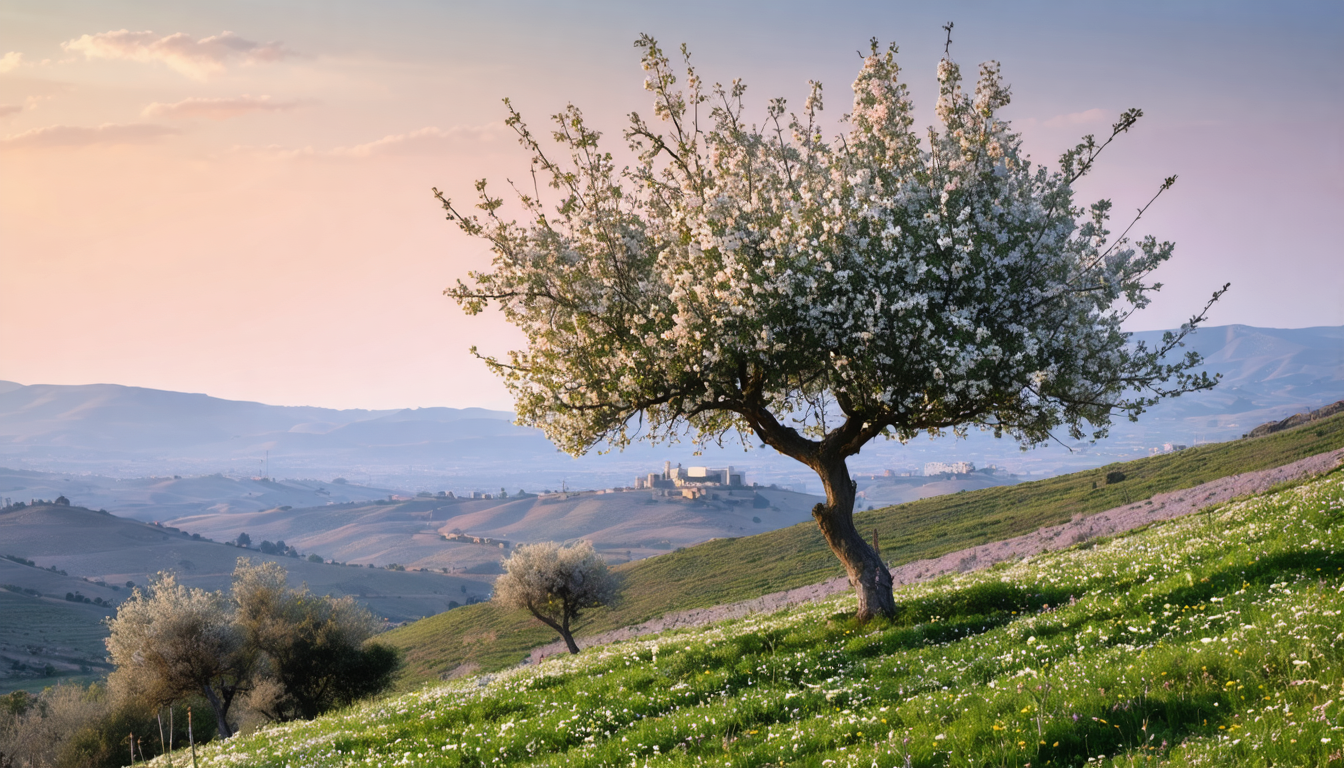
The Gemara teaches that for fruit trees, the determining factor isn't when you pick the fruit. It's the Chanatah — the moment the blossom falls away and a tiny bud forms in its place. That small bud is the starting point of the fruit's life, and that's what determines which "year" the fruit belongs to.
If the Chanatah happened before Tu B'Shvat, the fruit counts toward last year's Terumos and Maasros. If it happened after Tu B'Shvat, it belongs to the new year. Even if both fruits ripen on the very same branch just days apart, you have to separate them — because Halacha tracks the origin, not the outcome.
There's something remarkable in that idea. Two olives can look identical hanging side by side. But their Halachic identity was sealed weeks earlier, at a moment most people would never notice.
But what does this have to do with me?
Fair question. Most of us don't own fruit orchards. We're not separating Terumah in our kitchens every day. So why should Tu B'Shvat matter?
Because Tu B'Shvat isn't just a technical Halachic date. It's a yearly reminder that beginnings matter. The Chanatah — that quiet, almost invisible bud — is what determines the fruit's entire future. Not the harvest. Not the ripening. The bud.
Rav Wolbe teaches that real growth in Avodas Hashem often starts with tiny, barely noticeable shifts. A small decision to learn five more minutes. A quiet choice to hold back a sharp word. These are your "Chanatah moments" — and they determine what kind of fruit your life produces, long before anyone else can see it.
Tu B'Shvat asks us to pay attention to those beginnings.
Trees, Eretz Yisrael, and the Shivas HaMinim
There's another layer here. The custom on Tu B'Shvat is to eat fruit specifically from Eretz Yisrael — and many people focus on the Shivas HaMinim, the seven species the Land is praised for: wheat, barley, grapes, figs, pomegranates, olives, and dates.
Why? Because Tu B'Shvat is one of those quiet threads that ties us back to the Land. The entire system of Terumos and Maasros is built around Eretz Yisrael. When we eat those fruits on Tu B'Shvat, we're not just snacking — we're strengthening a bond that stretches back to the days of the Beis Hamikdash.
Even in Chutz La'aretz, far from any orchard or vineyard, biting into a date or a fig on Tu B'Shvat is a small but real act of connection. It says: I remember where I come from. I remember where I'm headed.
Why a minor holiday might be a major opportunity
Here's the thing about Tu B'Shvat. Because it's low-key — no Shofar, no Sukkah, no Megillah — it's easy to let it pass without thinking. But sometimes the quietest days carry the most potential.
Rabbi Dessler explains that the Jewish calendar isn't just a schedule. Each day is a spiritual doorway. When Tu B'Shvat arrives, there's a unique energy available — an opening to reflect on growth, patience, and the long game of becoming who Hashem wants us to be.
Trees don't rush. They grow slowly, steadily, and their roots go deep before their branches reach high. On Tu B'Shvat, we're invited to ask: Am I growing like that?
Five things you can do this Tu B'Shvat
Eat fruit from Eretz Yisrael with Kavanah. Before you bite into that fig or date, pause for a moment. Think about the land it grew in, the Kedushah of Eretz Yisrael, and the system of Terumos and Maasros it represents.
Learn the Halachos of Terumos and Maasros as a family. Even a 10-minute overview can transform Tu B'Shvat from a dried-fruit day into something meaningful.
Identify one Chanatah moment in your own life. Pick one small, positive habit you want to begin — and start it on Tu B'Shvat. Let the day mark your personal new year for growth.
Hold a simple Tu B'Shvat Seder. Many communities have the Minhag of a special Seder with different categories of fruit. It's a beautiful way to bring the family together around Torah ideas.
Say a sincere Brachah on each fruit you eat. Tu B'Shvat is a perfect day to slow down and focus on the words of your Brachos. Let each one be a moment of real Hakaras HaTov to Hashem for the incredible variety He put into the world.
Small buds, big fruit
Tu B'Shvat reminds us that the most important moments in life aren't always the loudest ones. A bud forms on a branch in silence. Nobody celebrates it. But that bud — that quiet beginning — determines everything that follows.
So the next time someone calls Tu B'Shvat a "minor holiday," smile. Because you know better. You know that sometimes, the smallest beginnings produce the greatest fruit.