How to Explain the Shofar to Children: A Rosh Hashanah Guide for Parents
On Rosh Hashanah morning, somewhere past the three hour mark, the longest davening of the year suddenly has everyone's attention. The Torah is returned to the Aron, the room stands, and the children who were counting ceiling tiles go still, because the one thing they came for is about to happen. Nobody explained the shofar to them. They are listening harder than anyone in the building anyway.
Then, on the walk home, the questions arrive. Why does a grown man blow a horn in shul? Why are some of the sounds broken into little pieces? A parent has about ninety seconds before the conversation moves on to lunch, and most of the work of explaining the shofar happens before anyone hears it.
A note for this year, Tishrei 5787 (September 2026). The first day of Rosh Hashanah falls on Shabbos, September 12, and the poskim rule that we do not blow shofar when Rosh Hashanah falls on Shabbos. The first shofar of 5787 is therefore heard on the second day, Sunday, September 13. Everything else in this guide applies in any year.
The Torah itself does something strange with this mitzvah.
וּבַחֹדֶשׁ הַשְּׁבִיעִי בְּאֶחָד לַחֹדֶשׁ יִהְיֶה לָכֶם שַׁבָּתוֹן זִכְרוֹן תְּרוּעָה
U'vachodesh hashevi'i b'echad lachodesh yihyeh lachem shabbason, zichron teruah.
"In the seventh month, on the first of the month, it shall be for you a day of rest, a remembrance of blasting." (Vayikra 23:24)
A second pasuk, Bamidbar 29:1, calls it yom teruah, a day of blasting. Notice what is missing from both. The Torah names the sound, twice, and never once names the instrument. Chazal derive the shofar itself from elsewhere, from the shofar teruah of Yovel. Why would the Torah command a sound and leave the horn to be deduced? Because the mitzvah is the sound, not the object. The horn is only the thing the sound has to travel through. That distinction will do most of the work below.
The year the shofar waits
A child who has been counting down to the shofar and hears nothing has every right to be confused. So we say the one sentence out loud before Yom Tov, not during it: this year the first day is Shabbos, so the shofar waits until Sunday.
Said plainly and in advance, the silence stops being a disappointment and becomes information: the shofar is not entertainment the shul owes us. It is a mitzvah with rules, and one of its rules is that it steps aside for Shabbos. A child who grasps that has already learned something real. Shabbos afternoon then becomes the rehearsal space, a quiet hour to teach the names of the sounds before Sunday morning ends the waiting.
A sound with no words
What should a child be thinking about when the shofar sounds? The classical answers are three, and each can be said in a sentence a child can hold.
The Rambam writes that although the shofar is a decree of the Torah, it carries a hint within it: it calls to those who are asleep to wake up, to look honestly at what they have been doing, to return, and to remember their Creator. For a child: the shofar is calling your name, asking you to think about the year.
The Sefer HaChinuch explains the shofar as a recalling of the Akeidah. Avraham and Yitzchak walked up the mountain ready to give Hashem everything, and at the last moment a ram appeared, caught in the thicket by its horns, and was offered in Yitzchak's place. For a child: the shofar is the sound of the bravest story in Chumash.
The Vilna Gaon explains that the shofar is a coronation. A king is proclaimed with a blast of the horn, and on Rosh Hashanah we crown Hashem as King, which is why a person should feel real simcha during the blowing, because willing joy is part of what accepting a King means. For a child: we are crowning Hashem, and this is the trumpet.
We can pick the one that fits our child this year. But a child will eventually ask why, if the shofar means all that, we do not just say it in words. Because a cry without words carries what words cannot, which is precisely why the Torah named the sound and not the horn.
Why nobody blows it on the first try
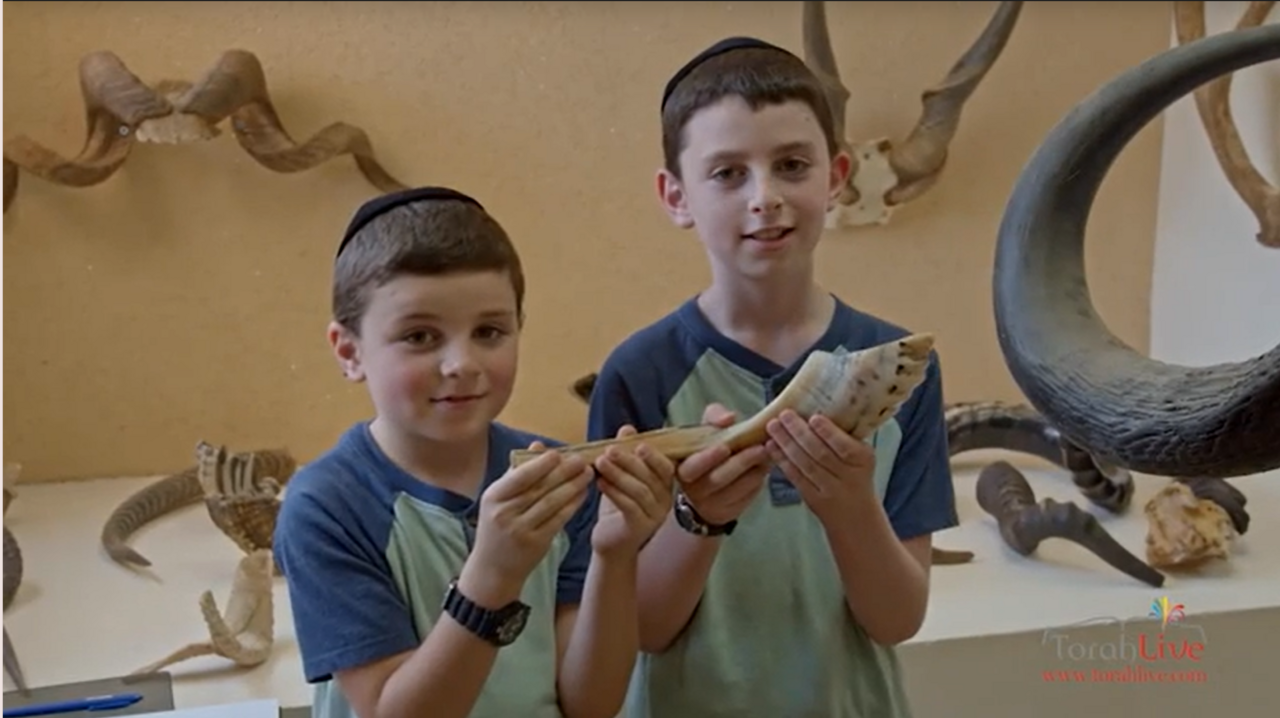
When we filmed the Shofar course, Rabbi Hadar Margolin, an educator who has been blowing shofar for more than thirty years, corrected the very first attempt on camera before any sound came out: the wrong end of the shofar was at the mouth. The thin end goes in. Even the presenter had to be taught.
The mechanics change how a child hears the sound, so they are worth giving honestly. A clarinet makes its sound with a reed; the wooden body only carries and amplifies what the reed does. A shofar has no reed. The lips are the reed. The vibration a child hears filling the shul is a person's own lips buzzing, amplified through the horn. The horn is not the instrument. We are.
That is why nobody blows it on the first try. Lips pressed too tight will not vibrate at all; too loose, and the air escapes silently. A beginner has to experiment, moving the shofar a little further in and out, moistening the lips, steadying the mouthpiece with two fingers. The broken sounds come from the tongue, not the lips. All of this is learnable, and the films in the Shofar course walk a beginner through it step by step. Nerves get their own film: a boy blowing in front of a crowd should loosen his collar, breathe deeply, and pause between sets, because tension lands directly in the weak muscles of the lips.
The shofar must be learned, which makes it the one mitzvah of the day a child can apprentice into, and practice is not wasted on children. Researchers followed seventy-three German primary school children for a year and a half. The children who were taught an instrument at school improved more on every verbal memory measure than the children who were not. The researchers were careful to note that the groups were not randomly assigned, so the study shows a pattern rather than a proven cause. Still, the pattern is one every parent recognizes. What a child hears and practices, a child remembers.
Consider, purely as an illustration, a scene from many homes each Elul. A father buys his son a shofar because the boy asked for one, and by the second week the whole house has learned to leave the room. Then one evening the sound arrives, full and clear, nothing like the squawks that came before it, and the boy blows it eleven more times to prove it was not luck. We see that the shofar is the rare mitzvah a child gets to fail at out loud, in front of people who love him, before he ever has to do it in front of anyone else.
Counting to one hundred
A child who can follow the count stops waiting for it to be over and starts listening for what comes next.
The Torah requires three teruos, and Chazal teach that every teruah needs a straight tekiah before it and after it, which gives nine blasts. But which sound did the Torah mean by teruah? A wail of three broken pieces, what we call shevarim? A stutter of nine short bursts, what we call teruah? Or both together? We sound all three possibilities, three times each, and reach thirty. The Gemara notes that many authorities hold this is not a genuine doubt at all: each of the three forms is a valid teruah, and the combined order was established so that every community would share one practice. The custom of hearing one hundred blasts is tied by Chazal to the hundred cries of the mother of Sisra. Thirty fulfills the Torah's requirement; one hundred is the custom.
Notice what the halacha counts and what it does not. It counts sounds, lengths, and sequences. It says nothing about polish. An unpolished Moroccan ram's horn and a gleaming lacquered one are worth exactly the same, because the horn was never the instrument.
What to do this week
- Say the one sentence out loud before Rosh Hashanah, not during it: this year the first day is Shabbos, so the shofar waits for Sunday.
- Teach the three names before shul, not in shul. Tekiah, one long sound. Shevarim, three broken ones. Teruah, nine short ones. A child who can name a sound will listen for it.
- Give a young child one job, in the words of the Torah Live film for little ones: at home we listen with our ears and we do not make a sound. One job is easier to keep than a rule.
- If a boy is learning to blow, have him practice on a friend's shofar before buying one, and buy the one his lips close around comfortably, not the most impressive one on the shelf.
- If he is blowing in shul, rehearse the recovery and not only the blast: loosen the collar, breathe twice, pause between sets if he needs to. Nobody in the room minds.
For children roughly three to six, Lessons for Little Ones has a Rosh Hashanah film built around exactly this preparation: the apples, the honey, the machzor, the sounds, and that one job for shul.
Questions parents ask
Why is there no shofar on the first day of Rosh Hashanah this year? The first day of 5787 falls on Shabbos, and the shofar is not blown then; the first blasts are Sunday, September 13. Check your shul's schedule.
What should we tell a child who is frightened by the sound? The truth helps: it is a person's own breath, made loud by a horn. Fear fades once a child has seen how the sound is made.
Can a woman or girl hear shofar at home? Yes. The course teaches that thirty blasts are sufficient outside of davening, a point people often miss. Whether a bracha is said differs between Sephardi and Ashkenazi practice, so ask your Rav.
What makes a shofar kosher? Species, cracks, and repairs are real questions with their own film in the course; a specific shofar goes to a Rav.
The horn will sit in its cupboard this Shabbos, and the sound will wait where it always waits, inside us, until Sunday morning lets it out. A child who spent the week learning the names of the sounds, buzzing his lips against a borrowed mouthpiece, and hearing why Avraham's ram matters, is not waiting for a noise anymore. He is listening for something he already knows. The full set of films on blowing, buying, and understanding the shofar is in the Shofar course, included with a Torah Live subscription, and signing up at torahlive.com/signup opens it for the whole family in time for Sunday's first tekiah.