
Why We Dance with the Torah: Explaining Simchas Torah to Children
On the way into shul, on the night the dancing begins, a child asks the question most adults have stopped noticing: why is nobody reading from the Torah tonight? Reading is the only thing anyone ever does with it. All year the scroll comes out, is read aloud, and goes back. Tonight it comes out and nobody opens it. They just carry it around in circles, for hours.
In the Diaspora this year the question lands late at night: Shemini Atzeres falls on Shabbos, October 3, and Simchas Torah follows on Sunday, October 4, so the dancing begins on Motzei Shabbos, at the end of a nine-day stretch of Yom Tov, with children who are past tired. We will plan for those children below. First the question deserves its answer, and the Torah gave it in its own final mitzvah.
וְעַתָּה כִּתְבוּ לָכֶם אֶת הַשִּׁירָה הַזֹּאת וְלַמְּדָהּ אֶת בְּנֵי יִשְׂרָאֵל שִׂימָהּ בְּפִיהֶם
V'atah kisvu lachem es hashirah hazos, v'lamdah es bnei Yisrael, simah b'fihem.
"And now, write this song for yourselves, and teach it to the children of Israel, place it in their mouths." (Devarim 31:19)
The last mitzvah in the Torah is to write the Torah down, and look at the word the pasuk chooses. Not "write this book," not "write this teaching." Write this song. Why a song? A song is not information. Nobody hums a contract. A book you can own by reading it once; a song you can only own by getting up and performing it, with other people, in time with them. One night a year, we take that word completely literally.
The night nobody reads
Say the answer to a child in one sentence, before Yom Tov: tonight nobody reads from the Torah, because tonight we carry it. The reading has a whole year, and on Simchas Torah we finish Devarim and begin Bereishis again. But the night belongs to the other half of the pasuk, the half about placing the song in every Jew's mouth. That is why the circles include the men who learn all day and the men who cannot read the Hebrew inside the scroll. A song does not check credentials. Everyone in the room has the same grip.
For the youngest children, Torah Live's film for little ones puts it at their exact height: Hashem gave us the best present in the world, and on Simchas Torah we hold the Torah tight and dance around the shul seven times, and all the children come and dance and sing. A three year old needs nothing more than that, plus a flag.
A song, not a book
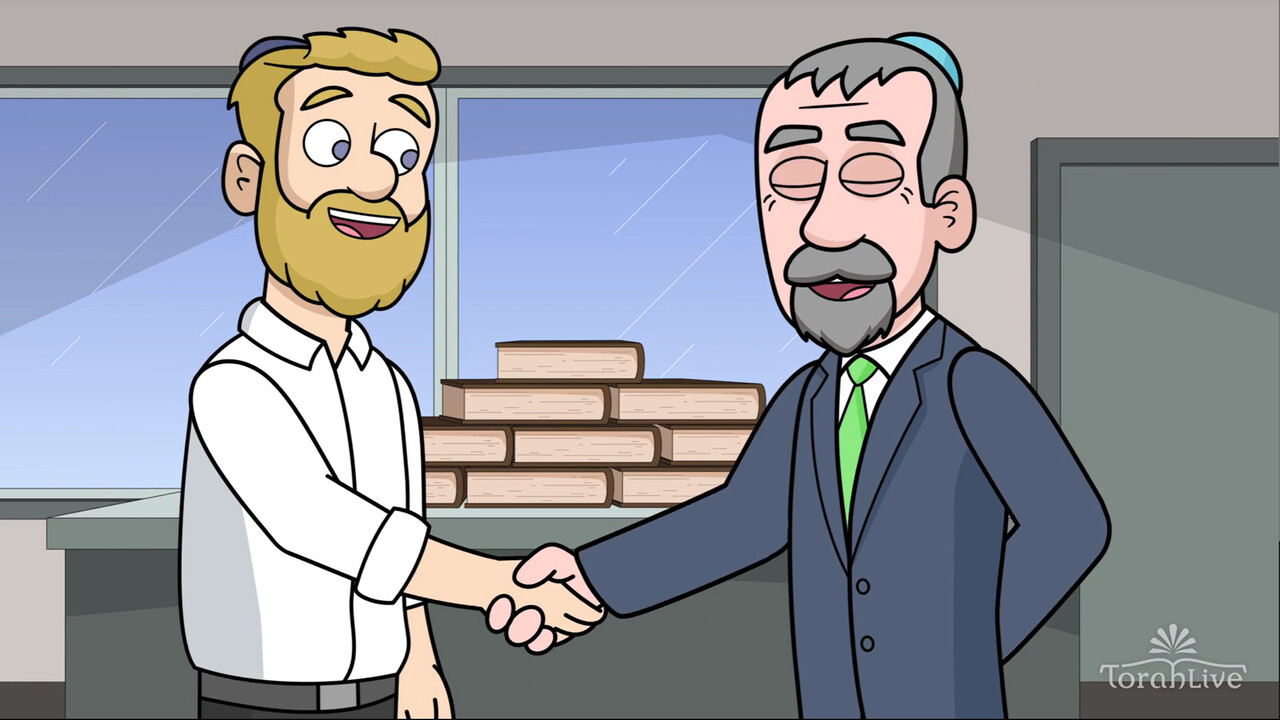
An older child will find the hole in our answer, and the hole has been noticed before. In the Torah Live Sefer Torah series, a father and son are learning together before the boy's bar mitzvah when the father explains that writing a Sefer Torah is the Torah's last mitzvah, a mitzvah to write a song, because the Torah is not a dry history book or law book; it is a song that touches the depths of the soul. The boy pushes back with the question every intelligent child finds: but nobody learns out of a Sefer Torah. He has never once seen it. We learn from printed chumashim and gemaros; the scroll is only read publicly and put away.
The boy is in good company. The Rosh, Rabbeinu Asher, one of the pillars of halacha, asks exactly this, and his answer redefined the mitzvah for every generation since. The mitzvah of writing a Sefer Torah, he explains, spoke to generations who studied directly from the scroll. Now that the scroll serves for public reading and we learn from chumashim, mishnayos, gemaros and their commentaries, the mitzvah attaches to writing those. The mitzvah moved with us. In the film, the boy takes the Rosh one cheerful step further and asks whether making something else people can learn from would count too, which is, as the Sefer Torah series tells it, how Torah Live itself began. We see that the scroll stopped being the thing we read from and stayed the thing we hold, which is exactly the difference between a textbook and a song.
There is a picture worth keeping from another Torah Live film, about how an Aron Hakodesh is made. At a workshop in Ma'ale Adumim, the craftsmen do not begin by carving. They begin by gluing plain raw planks together, layer on layer, purely for depth, and only when the block is thick enough does the carving begin, until the plain boards have become the crown of a shul. A year of learning looks like the gluing: week after week of parsha and mishnayos stacking up with nothing dramatic to show. Simchas Torah is the carving, the one night the year's plain accumulation is allowed to look like what it was for.
Why dancing was ever a question
A parent with a long memory may notice a second puzzle: is dancing on Yom Tov not restricted? It is, and the honesty of the answer is part of its beauty. Chazal restricted clapping and dancing on Yom Tov, a protective decree, out of concern that celebration might lead someone to repair a musical instrument. And later authorities record that on Simchas Torah the custom spread to dance in honor of the Torah, and the custom was allowed to stand. The Sages weighed their own decree against the honor of the Torah, and the Torah's honor carried it. Communities differ in how the night looks in practice, so follow your shul and ask your Rav.
Something measurable happens when people move together. Researchers put pairs of four year olds who had never met on side-by-side swings. Some pairs were swung in time with each other and some were swung out of time. The children who had moved in time then cooperated faster on a task that required them to work together, and it made no difference whether they could see each other's faces clearly. The sample was small and American and middle class, so we should not lean on it. But moving together does something to children that talking together does not. And still, the reason we dance is the Torah, not the psychology; the study only suggests why a child who joined one circle comes home different from a child who watched.
Holding what you were told never to drop
Now the paradox that sharp-eyed children raise on their own. All year we teach them: a sefer never goes on the floor, never upside down, never left open when you leave the room. And tonight adults are dancing with the holiest object we own. Is the dancing an exception to the respect?
It is the opposite. It is the same respect, at full volume. The halachos of honoring sefarim, taught in Torah Live's Honoring Sefarim course, draw a consistent picture: a sefer is not placed on the ground or on stairs, not used as an elbow rest, not left open and abandoned. The course points out the everyday failure with dry precision: benchers tossed down a Shabbos table. Tossing is the tell. We toss what does not matter. That is precisely why, tonight, the scroll is carried by an adult who is steady on his feet, handed on carefully when the holder tires, and never put down. The child watching has it exactly right: you do not treat a Torah casually. Dancing with it is not casual. It is the least casual thing a shul does all year, the year's carefulness turned into motion.
Said to a child in one line: the same rule that keeps a sefer off the floor is why only a grown-up who is steady carries the Torah tonight, and why he hands it on when he has had enough.
A plan for real children
Consider, as an illustration rather than a report, a mother who takes her five year old to the second hakafah with a paper flag and a plan to stay for four. They leave after the third, because the child has fallen asleep standing up, still holding the flag. On the walk home he wakes enough to ask whether the Torah gets tired too. We see that a child does not measure Simchas Torah in hakafos, and neither should we. The plan:
- Work backward from bedtime, not forward from the first hakafah. Decide before leaving the house which hakafah you are leaving after, and tell the children the number.
- Give a young child something to hold that is theirs. A flag, held tight, going around with everyone, is a complete Simchas Torah for a four year old.
- Say the one sentence in advance: tonight nobody reads from the Torah, because tonight we carry it.
- Answer the respect question before it is asked, with the one line above.
- With a bar mitzvah age child, watch the father-and-son film in the Sefer Torah series before Yom Tov: it is a parent explaining exactly this to a child.
- Plan Sunday morning as part of the night. A child who danced until eleven needs a slow morning, and Simchas Torah day is long.
The words we are dancing with
A child who dances with a closed scroll is celebrating something he cannot yet read. The dancing lands differently once he has spent a few evenings inside the words, because he is no longer holding an object he has been told to respect. He is holding the book the arguments came from.
Torah Live’s new animated Mishnah series makes that possible in the same season. It opens with Maseches Sukkah, narrated by Rabbi Gavriel Friedman, with Mishnah Man leading children through the words of the Tannaim. A family that learns the tractate of the festival across Sukkos arrives at Simchas Torah having actually finished something, which is the whole reason the dancing exists.
Begin with the opening Mishnah of Maseches Sukkah, or browse the series at The Mishnah, animated.
And to show a child what is inside the scroll he is dancing with:
Questions parents ask
Why do we dance with the Torah instead of reading from it? Because the Torah calls itself a song, and a song is honored by being carried and sung, not only studied. The reading resumes in the morning.
What is Kol Hane'arim? An aliyah at which the children are called up together, often under a large tallis. Customs differ, so ask what your shul does and whether your child joins.
How many hakafos are there, and must we stay for all of them? Seven, and no, a family with young children does not owe the room its bedtime. Choose your number in advance.
Why is Simchas Torah on a different day in Israel? In Israel, Shemini Atzeres and Simchas Torah fall on the same day; in the Diaspora they are two days, which is why the dancing here begins Motzei Shabbos this year.
Do we still eat in the sukkah on Shemini Atzeres? Practice genuinely differs by community. Ask your Rav.
The child at the door asked why nobody reads tonight, and the answer has been waiting in the Torah's last mitzvah all along: because a song is not read. The reading was the year, the plain planks glued patiently week after week, and tonight is the carving, when a whole shul stands up to show the children that the book we are so careful with is the thing we are happiest about. Choose your hakafah number, hand out the flags, and say the sentence at the door on the way in. Before Yom Tov, the Sefer Torah series and Honoring Sefarim are included with a Torah Live subscription at torahlive.com/signup, and they will change what a child sees when the Aron opens.