
You decide how you feel: the middah of happiness
Ever notice how two people can face the exact same bad day, and one falls apart while the other stays calm? Same traffic, same broken dishwasher, same difficult news. One is miserable. The other keeps smiling. What's the difference between them? It comes down to one powerful idea: you decide how you feel.
When hard news reaches us, whether from Eretz Yisrael or from our own front door, it's tempting to believe our emotions are out of our hands. But the Torah teaches something remarkable. Happiness is a middah, a character trait you build, not a mood that happens to you.
Happiness is a middah, not an accident
Think about the person who says, "He made me angry." The truth is, nobody can make you angry. You decide to become angry, or you decide not to. As Rabbi Siddur explains, you're not an animal reacting on instinct. You're a thinking person who chooses your response to everything that happens in this world.
There's a story about a shopkeeper who got screamed at for 15 minutes by an upset customer. He never flinched. Afterward someone asked him how he stayed so calm. He said, "I have a heart condition. If I get upset, I could die. Is it worth dying over this?" He decided he wasn't going to get angry, and that decision was entirely his. Takeaway: Next time someone pushes your buttons, pause and remind yourself that the choice to react is yours alone.
Why things go wrong (and why that's a good sign)
Here's a question that troubles many of us. If Hashem loves us, why do things go wrong so often? The Gemara offers a striking answer. If a person never has a single problem in life, they should actually be afraid that Hashem gave up on them.
Consider the curse Hashem gave the snake: "You'll eat the dust of the earth." The Gemara explains this means the snake will always find food, wherever it goes. That sounds like a blessing. So why is it a curse? Because it means the snake never needs to turn to Hashem. Every other animal cries out during a drought. The snake never does. Takeaway: When you hit a bump, reframe it as an invitation to turn toward Hashem, the way a caring parent sets loving limits because they want to see their child succeed.
Nobody can touch what's inside you
During the years of Soviet oppression, Jews who tried to keep Torah and mitzvos were jailed and sent to Siberia. Natan Sharansky endured this for years. When he was finally released, people expected a broken man. Instead he came out smiling and cracking jokes.
Asked how he stayed happy through all of it, he pointed to his head and said, "Because I'm up here. Whatever they do to my body, they can never touch me." This is the heart of the matter. External circumstances press against us, but the decision of how to feel lives in a place no one else can reach. Rabbi Wolbe's approach to building character teaches exactly this: real growth begins with self-awareness, recognizing that your inner response is always yours to shape. You can bring this idea to life in the I Decide How I Feel video, part of the Strengthen our Nation course.
Happiness is contentment, not a thrill
We often chase happiness as if it were a spark of excitement. But real happiness is quieter than that. It's contentment. Someone once asked the Baal Shem Tov how to learn to be happy, and he sent them to Reb Zusha, a man who was poor, sick, and burdened with troubles.
When the visitor explained he wanted to learn how to deal with unhappiness, Reb Zusha replied, "I wish I could help you, but I've never been unhappy a day in my life." His secret wasn't an easy life. It was a heart that decided to see good and to trust Hashem in every situation. Takeaway: Stop waiting for the perfect circumstances to feel content. Contentment is a decision you make right now.
Put it into practice today
Ideas only change us when we act on them. Here are a few simple ways to start deciding how you feel today:
Pause before you react. When something upsets you, take three slow breaths and remind yourself that the choice to get angry is yours. This is the middah of happiness in action.
Name one good thing in a hard moment. When things go wrong, find a single point of gratitude. This trains you to see good instead of bad, just like Reb Zusha.
Turn a problem into a prayer. The next time life throws you a challenge, whisper a few words to Hashem. Remember, the animals who cry out during a drought are the ones Hashem hasn't forgotten.
Guard your inner space. Once a day, remind yourself that no person and no situation can touch how you decide to feel. That space belongs to you and to Hashem.
So the difference between the person who falls apart and the person who smiles isn't luck or an easy life. It's the quiet, powerful decision that you decide how you feel. Am Yisrael has walked through centuries of hardship and come out stronger every time, because we know that our inner strength lives somewhere no one can reach.
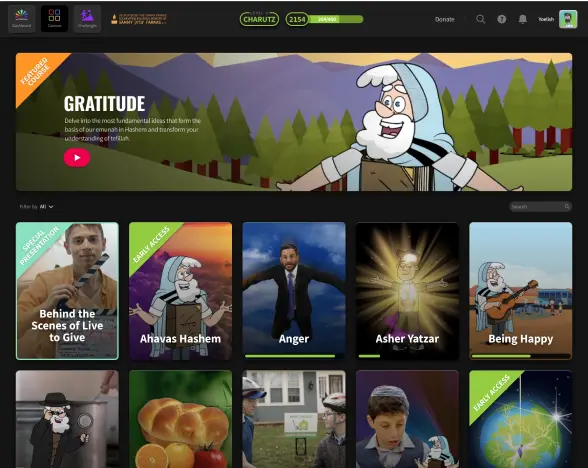
Ready to bring this strength home to your family? Step into Torah Live's world of stunning videos, games, and challenges that make Torah learning something kids actually beg for. Every bit is 100% clean, fun, and maaser approved. Start your family's Torah adventure and watch screen time become soul time.